
Richard Saunders, Phnom Penh
Taiwan’s Ministry of Economic Affairs (MOEA) is collaborating with the Industrial Technology Research Institute (ITRI) and leading domestic firms to develop indigenous four-legged robots, aiming to secure a foothold in the rapidly expanding global robot dog market, projected to exceed US$4 billion by 2035.
The initiative seeks to capitalize on Taiwan’s core strengths in information and communications technology (ICT), semiconductors, and precision machinery. By fostering local innovation, the program aims to build a self-reliant technology ecosystem and establish a non-China-dependent supply chain.
“Technology is progressing from traditional robotic arms to more advanced wheeled, quadruped, and humanoid robots equipped with autonomous mobility,” the ministry stated. Fueled by breakthroughs in generative AI, visual recognition, sensors, and high-performance computing, modern robots are increasingly capable of independent “thinking,” prompting nations worldwide to vie for dominance in the sector.
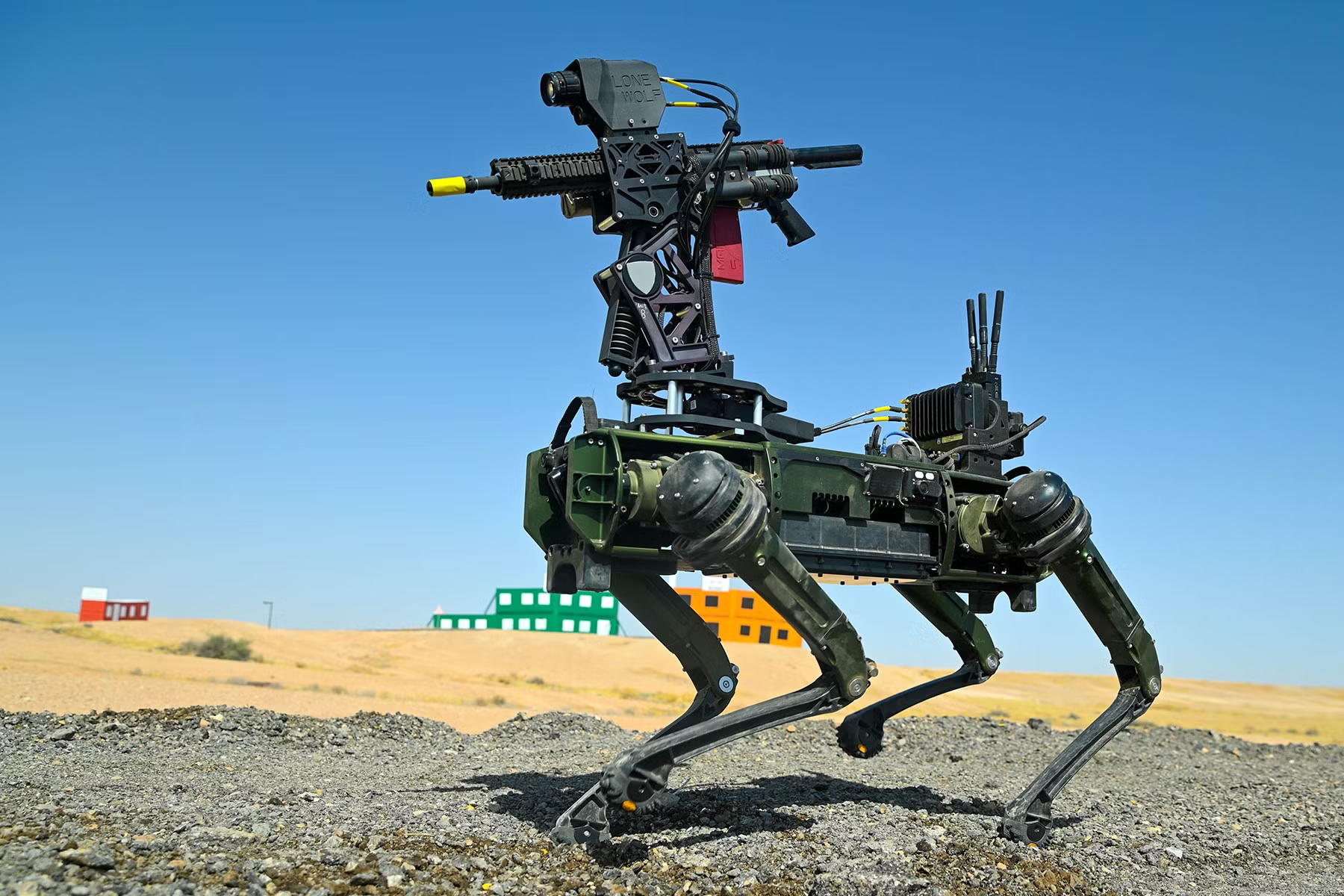
The global quadruped robot market is currently dominated by American and European companies. Notable players include U.S.-based Ghost Robotics, which specializes in military and defense applications, and Switzerland’s ANYbotics, focused on industrial inspections in power and petrochemical industries. Many manufacturers have invested over two decades in this field.
According to the ministry, quadruped robots are gaining traction across industrial and consumer segments. The industrial segment alone is expected to grow from under US$1 billion last year to more than US$4 billion by 2035.
ITRI developed the core platform in just 18 months, achieving breakthroughs in key areas including components, modules, full-machine control systems, and AI software. The open platform enables Taiwanese companies to contribute expertise in critical technologies such as motors, LiDAR (light detection and ranging), controllers, inertial measurement units, AI computing platforms, and system integration.
Several prominent firms have already joined the effort, including Solomon Technology Corp, Compal Electronics, Inventec Corp, Teco Electric & Machinery, Compertum Microsystems, and NexCOBOT. These partners are developing domestic modules and prototypes based on the ITRI platform.
To speed up development, the team leveraged Nvidia’s Taipei-1 supercomputer and the Omniverse digital twin platform for large-scale virtual training. More than 4,000 virtual robot dogs were trained simultaneously before real-world deployment.
The platform has already validated four major applications: firefighting and disaster response, underground tunnel inspections, autonomous navigation, and swarm operations. The firefighting robot, in particular, has successfully passed capability tests and can perform detection and search-and-rescue missions in extreme high-temperature, toxic, and flammable environments.
Future deployment targets include energy facilities, petrochemical plants, smart logistics, and public safety sectors — areas that could significantly boost Taiwan’s smart robotics industry.
In a related development, the National Chung-Shan Institute of Science and Technology (NCSIST) is advancing its own robot dog program. NCSIST President Lee Shih-chiang recently told lawmakers that the system, which debuted last month, is being produced locally under U.S. technology licensing. Mass production and military procurement are slated to begin in 2028.
NCSIST’s robot dogs come in three configurations — LiDAR, reconnaissance, and combat — and are designed for diverse missions including base patrols, beach defense, urban warfare, and multi-domain uncrewed operations. Lee emphasized that applications extend beyond combat to routine tasks such as security patrols and facility inspections.
The timeline for full-scale production will depend on feedback from military users, with different variants tailored to specific operational needs.