By Frank Williams
Vientiane
The opening of a joint Chinese-Laotian air support and training center is part of Beijing’s long-running effort to project power toward the Indian Ocean, a Taiwanese defense analyst said.
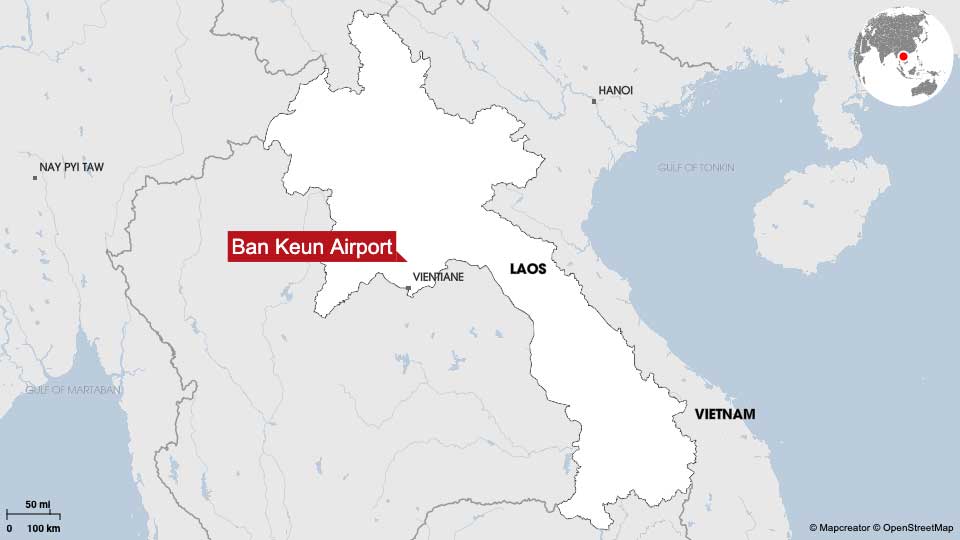
China’s Ministry of National Defense announced last Wednesday that the China-Laos Joint Support and Training Center at Ban Keun Airport in Vientiane Province, together with the China-Laos Friendship Aviation Academy, formally opened the previous day. Beijing said the jointly run facility is intended to strengthen pilot training for Laos.
“It is not directed against any third party and contributes to enhancing practical military cooperation as well as promoting regional peace and stability,” the Chinese defense ministry stated.
Su Tzu-yun, director of Defense Strategy and Resources at Taiwan’s Institute for National Defense and Security Research, described the project as another element of China’s strategy to expand its influence beyond its borders. Since the launch of the Belt and Road Initiative, he said, Beijing has been preparing the ground for overseas naval and air facilities, mainly to secure shipping lanes in the Indian Ocean and reduce dependence on the Strait of Malacca.
The People’s Liberation Army already maintains a military outpost in Djibouti and has access to Cambodia’s Ream Naval Base. The new center in Laos, Su argued, would help the PLA extend its reach toward the South China Sea, the Indian Ocean and the Strait of Malacca. The facilities form part of a larger approach aimed at protecting China’s maritime supply lines with naval and air power so that, should the Malacca Strait be blocked, oil and gas could still reach China by alternative routes.
Ban Keun Airport, roughly 45 kilometers northwest of the Laotian capital, already has a paved runway about two kilometers long—long enough for fighter jets. Su suggested China might later seek to lengthen it to three kilometers to handle larger aircraft such as bombers, transports and tankers.
In a potential conflict in the South China Sea or the Taiwan Strait, he added, U.S. Air Force aircraft operating from Diego Garcia in the Indian Ocean would likely have to cross the Indochina Peninsula from west to east, leaving them more vulnerable to Chinese interception.