Richard Sanders, Bangkok
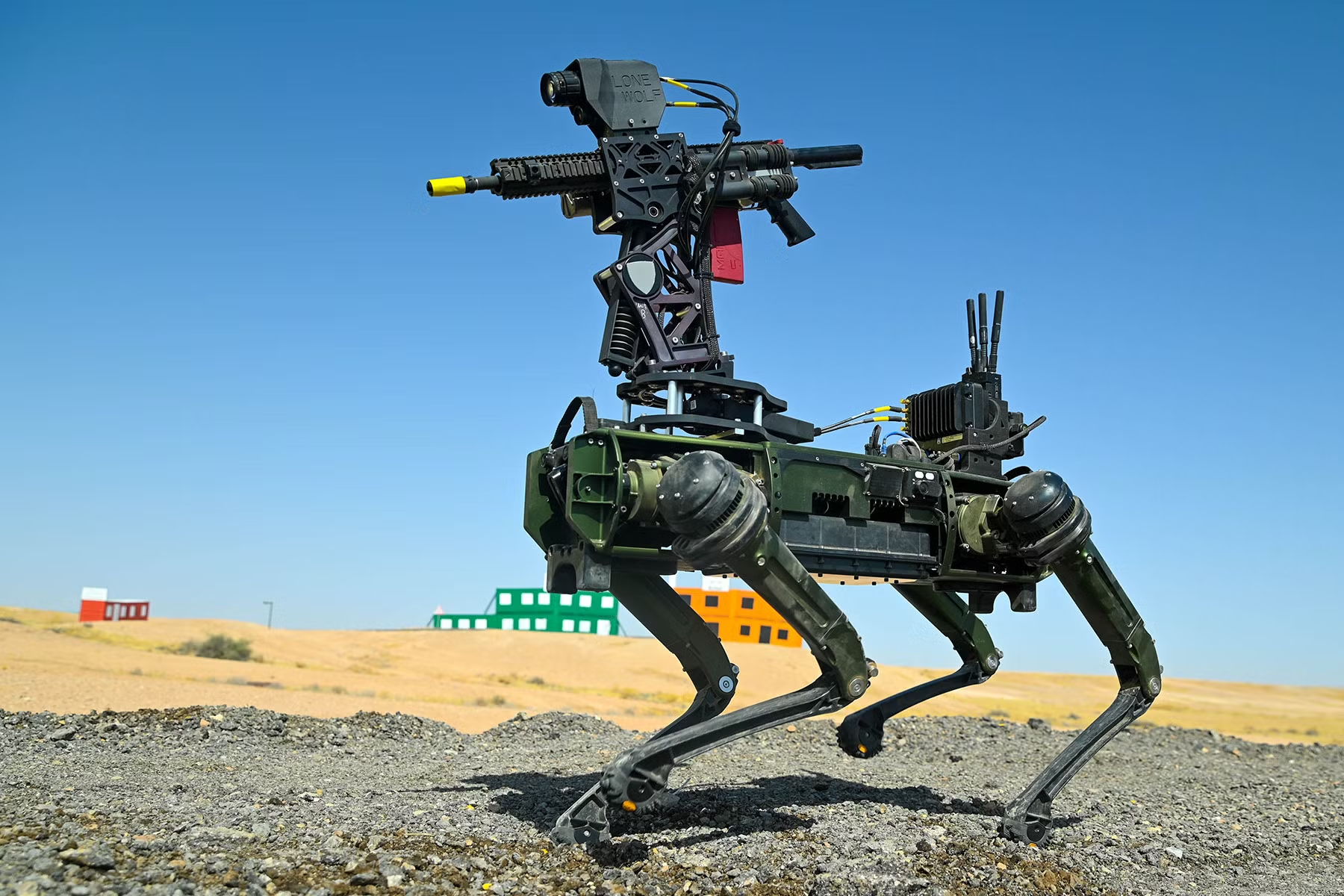
A Taiwanese defense research institute has revealed a new generation of weaponized quadruped robots — commonly dubbed “robot dogs” — built for coastal surveillance, reconnaissance, and dangerous frontline operations. The machines made their public debut at a showcase held in Taipei this week.
The National Chung-Shan Institute of Science and Technology (NCSIST) put three armed robotic quadrupeds through their paces, demonstrating their ability to walk, crouch, and traverse rough terrain. The designs are reportedly derived from the Vision 60 platform, originally developed by American defense robotics company Ghost Robotics.
The lineup covers three operational roles — reconnaissance, direct combat support, and LiDAR-based mapping — and is engineered to function across all weather conditions for tasks including patrol, perimeter defense, and target tracking. Each unit tips the scales at approximately 52kg and can move at up to 2.5 meters per second.
Jen Kuo-Kuang, deputy director of NCSIST’s Missile and Rocket Research Division, confirmed that early-stage discussions with the Taiwanese military are already underway. He noted that the armed forces view the robots as an urgent capability gap-filler, particularly for coastal monitoring, maritime patrol support, and base security operations.
Taiwan’s government has recently approved a dedicated defense budget supplement of roughly $280 million earmarked for arms acquisitions from the United States, reflecting the island’s sustained effort to bolster its defenses amid ongoing friction with Beijing.
Chinese authorities have also continued to push back sharply against Taipei’s deepening military relationship with Washington, framing ongoing US arms sales and defence cooperation as unacceptable interference in Chinese sovereign affairs. On the American side, President Donald Trump has framed arms shipments to Taiwan in notably transactional terms, describing them as a useful bargaining lever in dealings with Beijing, while simultaneously expressing support for preserving stability across the Taiwan Strait.
The Bigger Strategic Picture
Moving forward, it has become increasingly clear — drawn from hard lessons observed in Ukraine and Iran — that the future of Taiwan’s defense may hinge far less on traditional military hardware than on the intelligent integration of emerging technologies. The conflicts in Ukraine demonstrated in stark terms how drone swarms, autonomous ground vehicles, and networked sensor systems can reshape the battlefield calculus for a smaller force defending against a larger one. Iran’s use of low-cost unmanned systems further underscored how asymmetric autonomous platforms can punch well above their weight.
For Taiwan, facing potential amphibious and aerial pressure across a narrow strait, these lessons translate directly. A layered defence architecture combining autonomous patrol robots like these quadrupeds, unmanned surface and underwater vessels, AI-driven video analysis, distributed sensor grids, and real-time battlefield intelligence platforms could prove far more cost-effective — and strategically decisive — than static fortifications alone. The ability to saturate a contested coastline with intelligent, networked autonomous systems, while feeding live situational awareness to human commanders, represents a force-multiplier that conventional arms purchases cannot easily replicate.
Taiwan’s robot dog program is a meaningful step in that direction — but it is arguably just the opening move in what needs to become a much broader, faster embrace of autonomous and AI-enabled defense technology.