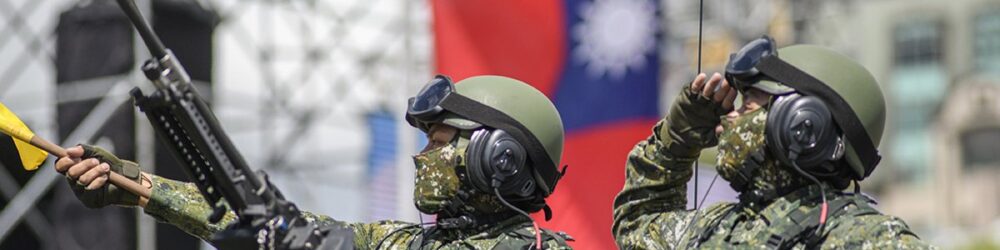
Frank Williams TAIPEI — Taiwan kicked off its major annual military exercises on Wednesday, emphasizing commanders’ ability to adapt quickly when battlefield conditions deviate from plans, while introducing temporary mobile internet slowdowns for the first time to prepare civilians for disrupted communications.
The 10-day Han Kuang drills began early after an underground command center in Taipei transmitted the start order. This triggered readiness measures including the dispersal of fighter jets and urgent naval deployments, according to two senior officials familiar with the plans who spoke on condition of anonymity because of the sensitivity of the operations.
For the first time, the exercises will incorporate a “backbrief” method drawn from U.S. military practice. Junior officers receiving orders will restate key mission details to their superiors to confirm mutual understanding of operational goals. “The move is to ensure commanders and subordinates are in sync on operational intent,” one official said.
A central focus is the risk that China would seek to disable command centers, ports, logistics hubs and defense industry facilities at the outset of any conflict. China’s Ministry of National Defense did not respond to a request for comment.
Held every year since 1984, this iteration will deliberately throttle mobile internet speeds for the first time to examine how the public would stay connected if bandwidth became limited. The military will also practice relocating a major arsenal under wartime conditions, mobilizing civilian factories for support, and conducting escort operations off Taiwan’s Pacific coast amid concerns that Beijing could attempt to cut supply routes from allies.
“These are all part of a series of toughening exercises. This is no longer a laboratory-like exercise in a vacuum,” a third senior defense official said, also requesting anonymity. “You are entering a real field environment, facing real bottom-line conditions. We hope the final phase of training reaches that state.”
The approach reflects Taiwan’s broader push for more realistic training after earlier criticism that some drills appeared overly staged. It builds on resilience exercises that test local officials’ capacity to maintain government functions through cascading emergencies, whether natural disasters or invasion scenarios.
Commanders will confront unexpected developments and must demonstrate how they reassess situations, adjust plans and issue new orders rapidly. More than 20,000 troops are expected to take part, including roughly 5,000 reservists.
The drills will also feature an “embedded reporter” system to evaluate wartime frontline information releases and strategies for countering adversarial disinformation. “The emphasis will be on how our entire population, the Republic of China as a whole — especially our citizens — should face war,” the defense official said.
The exercises are scheduled to conclude next Friday.