Frank Williams, Vientiane-Visiting US Representative Young Kim on Friday pressed Taiwan’s Legislative Yuan to quickly approve funding for the purchase of domestically produced drones, saying the island must strengthen its defenses against security threats from China.
The Cabinet has put forward a draft law that would authorize up to NT$210 billion (US$6.5 billion) for the acquisition of Taiwan-developed reconnaissance and attack drones, as well as uncrewed surface vessels. The measure is currently under review in the opposition-controlled legislature, where it competes with 13 alternative proposals.
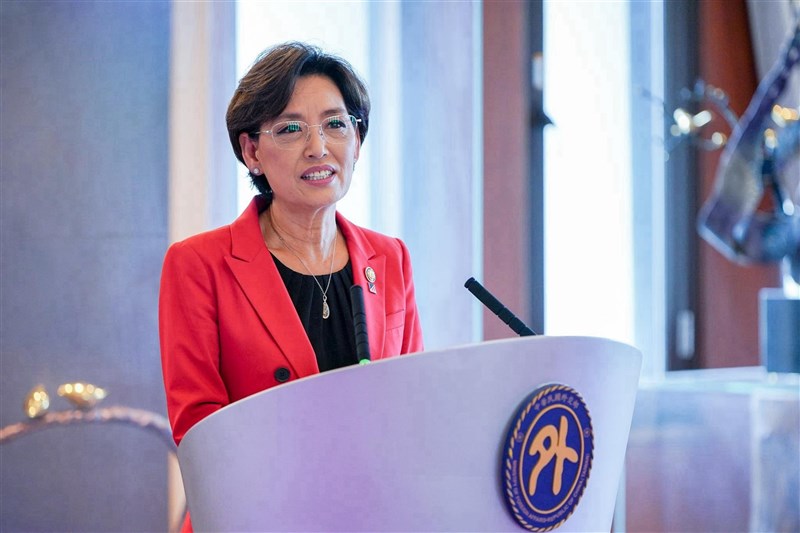
Kim, who is heading a bipartisan US congressional delegation, spoke to reporters after meeting President William Lai at the Presidential Office in Taipei. She noted that her visit followed joint naval patrols by China and Russia in the Pacific Ocean, which she described as efforts to “intimidate the free people of the Indo-Pacific.”
While praising Taiwan’s significant efforts to improve its defenses against the Chinese Communist Party and the strong bipartisan backing Taiwan enjoys in the US Congress, Kim stressed that both sides “must do more and do it quickly.”
“In the 21st century, drones are central to warfare,” she said. “We hope that the Legislative Yuan can send a strong demand signal to build and buy as many drones as possible, and do it quickly.”
The California Republican also pointed to Taiwan Semiconductor Manufacturing Co’s recent investment plans in Arizona, along with growing people-to-people connections, as evidence of a strengthening partnership between Taiwan and the United States.
Earlier on Friday, President Lai told the US visitors that Taiwan is well-positioned to expand its drone industry. Drawing on its strengths in semiconductors, precision machinery, and information and communications technology, Taiwan has built capabilities covering research, development, testing, and large-scale production of drones to meet defense needs, he said.
Lai noted that the government-backed National Chungshan Institute of Science and Technology has successfully completed rigorous US cybersecurity reviews for drone manufacturing, showing it can meet international standards while safeguarding sensitive technologies.
“We look forward to working with the United States to build secure and reliable non-red supply chains,” Lai said, referring to drone supply chains free of Chinese components.
He also expressed gratitude to Kim, who chairs the East Asia and Pacific Subcommittee of the US House Foreign Affairs Committee, for her longstanding efforts to advance Taiwan-friendly legislation in Congress.
The US delegation includes Kim, Democratic Representative Suhas Subramanyam, and Republican Representatives Michael Cloud and Randy Feenstra, according to Taiwan’s Ministry of Foreign Affairs.
The group also met with Defense Minister Wellington Koo at the Ministry of National Defense, where the two sides discussed Taiwan-US security cooperation and broader Indo-Pacific issues.