
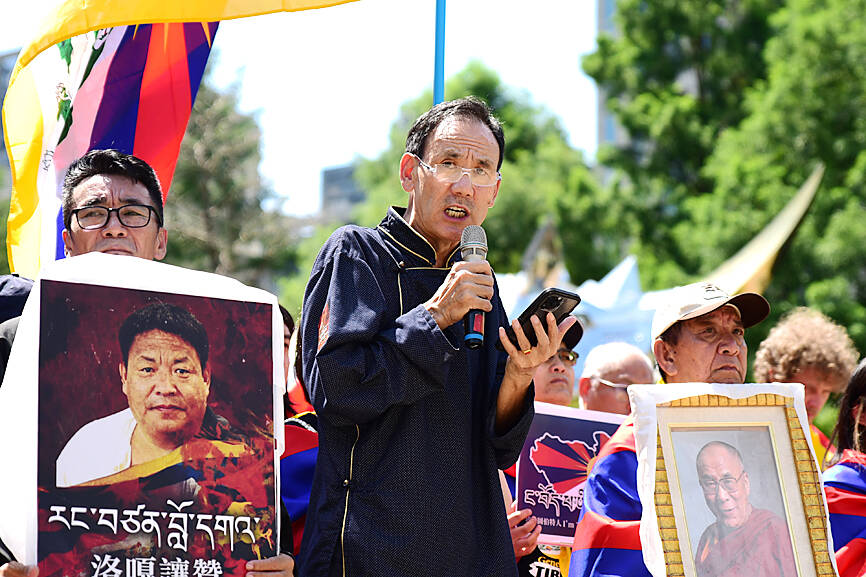
Frank Williams TAIPEI — Tibetan and human rights activists gathered outside the Bank of China’s Taipei branch yesterday to protest China’s newly enacted Ethnic Unity and Progress Promotion Law, urging people worldwide to resist Beijing’s authoritarian policies and speak out for oppressed ethnic minorities.
The demonstration coincided with the one-month anniversary of Tibetan activist Lobga Rangzen’s self-immolation in protest. His family had hoped the date would serve as a “global action day,” encouraging Tibetan communities and human rights organizations around the world to stage coordinated actions.
Groups including the Human Rights Network for Tibet and Taiwan, the Tibet Religious Foundation of His Holiness the Dalai Lama, and the Taiwan Tibetan Welfare Association held a news conference at the site. Participants, including Tibetans living in Taiwan and Taiwanese supporters, also staged a “die-in” to highlight the ongoing oppression.
Kelsang Gyaltsen, chairman of the Tibet Religious Foundation of His Holiness the Dalai Lama, noted that countless Tibetans, including Rangzen, have died defending their freedom. He called on all who value human rights to condemn China’s authoritarian rule and accused the United Nations of complicity through silence. “How many more Tibetans must lose their lives before the world listens?” he asked.
Tibetan activist Tashi Tsering declared, “Tibet belongs to the Tibetan people,” and demanded that Chinese troops leave the region. He warned that the new law could criminalize teaching Tibetan Buddhism or the Tibetan language to children, saying China aims to eradicate Tibetan religion and culture—“but we will not let them succeed.”
Human rights advocate Lee Ming-che criticized the legislation for going beyond regulating external behavior. While laws in democratic societies maintain public order by addressing outward actions, he said, this measure seeks to control people’s inner thoughts by requiring the promotion of “ethnic unity” even in workplaces and private homes. Lee compared it to a criminal organization’s code of conduct for intruding into personal beliefs and family life.
He added that the inclusion of the word “progress” in the law’s title reveals Beijing’s definition of advancement: eroding minority cultures, undermining Hong Kong’s “one country, two systems” framework, and pursuing the annexation of Taiwan. China views minority groups who choose their own cultures and Taiwanese people who choose their own future as “savage,” Lee said. “If China’s definition of progress means forcing us to give up the right to choose our future, we will show you the pride of being savages.”